How To Require Two-Factor by Role With BetterShield?
Ask chosen roles to set up two-factor: the grace period and its clock, what people see before and after it, store roles, and the network floor.
With BetterShield, ask chosen roles to set up two-factor: the grace period and its clock, what people see before and after it, store roles, and the network floor.
What it does
In BetterShield, Require two-factor of a role asks every account in the roles you pick to set up two-factor with an authenticator app. It is under What the site requires on BetterShield › Protection › Two-Factor. It is enforced inside the dashboard, never at the sign-in page: the password always signs people in, and what waits for them after the grace period is the setup screen.
- During the grace period, the person works as normal and sees a notice on every dashboard page: “This site asks accounts like yours to use two-factor sign-in. You have 12 days left to set it up.” with Set it up now.
- Three days before the deadline, the account is emailed once, “Set up two-factor sign-in for [site name]”, with the date and a link to where it sets it up. With a grace period of three days or less there is no email, and none goes out while safe mode is on.
- After it, every dashboard page sends them to the setup screen until they finish. People who manage BetterShield go to Protection › Two-Factor; everyone else goes to Two-factor sign-in on their profile, which says “This site requires two-factor sign-in for your role.”
- Still open after it: their profile, signing out, the front of the site, and tools that use the REST API. Everything else in the dashboard waits, the post editor included.
- Once they finish, the dashboard is theirs again straight away.
Only the app codes count. A passkey does not satisfy this requirement, even one that signs in without a code.
Step 1: Open Require two-factor of a role
Tick the roles under Require two-factor of a role. Every role on the site is listed.
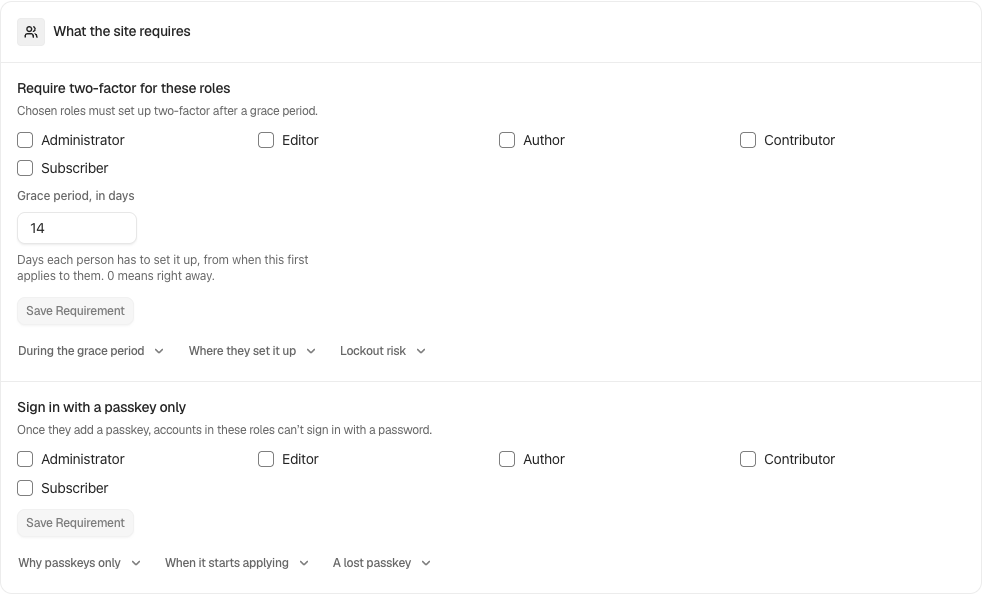
Step 2: Require two-factor of a role, with a grace period
- Set Grace period, in days.
- Press Save requirement.
| Option | What it does | Default |
|---|---|---|
| Roles | Each ticked role is asked to set up two-factor. | None ticked |
| Grace period, in days | How long each account has, 0 to 90. 0 sends people to setup on their next dashboard page. Anything else shows “Enter a number of days from 0 to 90.” | 14 |
The clock
- An account’s window starts the first time it opens a dashboard page, including its profile, while its role is ticked. Not when the account was created, and not at sign-in. Accounts that have existed for years get the full window.
- An account that never opens the dashboard, its profile or My Account › Sign-in security never starts its clock.
- Untick a role and tick it again later, and its accounts get a fresh window.
- An account that leaves the ticked roles loses its clock, and gets a fresh window if it comes back.
- People in a ticked role cannot turn their own two-factor off, outside safe mode; an administrator can. An account that sets up two-factor and later turns it off keeps its original deadline. If that has passed, the dashboard sends it to setup at once.
The recovery check
Adding a role first checks your way back in. If there is no working recovery link and no unused recovery code, or the recovery options were not checked in the last day, Check the way back in first opens with the reason:
- Check now runs the check, then tries the save again.
- Open Recovery goes to Protection › Recovery when something is missing.
- Go ahead anyway saves regardless, and the activity log records “Sign-in change made without a recovery check”.
- Cancel saves nothing.
Removing a role or keeping the same roles is never held up. See Set up recovery.
When you answer Me and a team in Quick Setup, it points you to Protection › Two-Factor, where you can require two-factor for administrators. Quick Setup itself does not set the requirement.
Recommended settings
We recommend Administrator and Editor, with the default 14 days: long enough for someone on holiday, short enough to finish in one sprint. Set up your own two-factor before you save, because the requirement covers you too.
| Site | What we recommend |
|---|---|
| Blog or brochure site | Administrator, plus Editor if anyone else publishes. |
| Store (WooCommerce) | Administrator, Editor and Shop manager. Leave Customer unticked: WooCommerce keeps customers out of the dashboard, so the requirement never sends them to setup, and would only show a countdown on their Sign-in security tab. |
| Membership or course site | Administrator, Editor and any staff role that edits content. Leave member roles unticked. |
| Agency or many sites | Administrator as the network floor (below), or ticked on each client site, with 14 days and a note to the client’s team before you save. |
Authors and contributors can be added once the first group has finished. A shorter window, such as 7 days, suits a small team you can talk to directly.
What it can break, and how to undo
- Someone without a phone can use any app that makes six-digit codes, such as a password manager that does (1Password and Bitwarden both can). Backup codes cover a lost phone.
- Roles WooCommerce keeps out of the dashboard are never sent to setup. If they open My Account › Sign-in security, that tab starts their clock and shows the countdown, but nothing is withheld. When you tick one, the screen says so, and they can still set up two-factor there.
- An overdue person cannot reach the editor until they finish setup. Everything they need is on their profile.
- To undo, untick the role and press Save requirement. Removing a role or lengthening the grace period asks for your password when Ask for my password before removing a protection is on.
- Safe mode, from your recovery link, stands the requirement down: no countdown and no redirect while it lasts.
Final Outcome
The Two-factor required for tile names the roles.
- Activity log: “Two-factor requirement changed” (Medium; High when a role comes off or the grace period grows, and then emailed as it happens (when instant alerts are enabled)), then “Two-factor turned on” as people finish.
- On someone’s account under Users, the Two-factor sign-in section says whether it uses two-factor. A per-role report of who has a second factor is part of BetterShield Ultra (see Sign-in report).
On multisite
Require two-factor across the network, on BetterShield › Network, is a floor for every site.
- Each site enforces the network’s roles plus its own. Unticking a role the network requires is refused: “Two-factor is required of these roles for the whole network, so this site cannot take them off its own list”.
- Where the network sets a grace period, the shorter of the network’s and the site’s applies.
- Each site’s clock still runs from when that site first saw the account.
- The network can name the main site’s roles and the five WordPress ships with. A site without one of those roles is not affected by it.
- The card starts as Not set and saves with Save. Only a network administrator can change it.
Related
- Two-factor with an app
- Two-factor and passkeys
- Passkey-only sign-in
- Set up recovery
- Multisite networks
This is how you can require two-factor by role with BetterShield.
Getting Stuck? Feel free to contact our Dedicated Support Team.